
ART@TRX Winner Spotlight
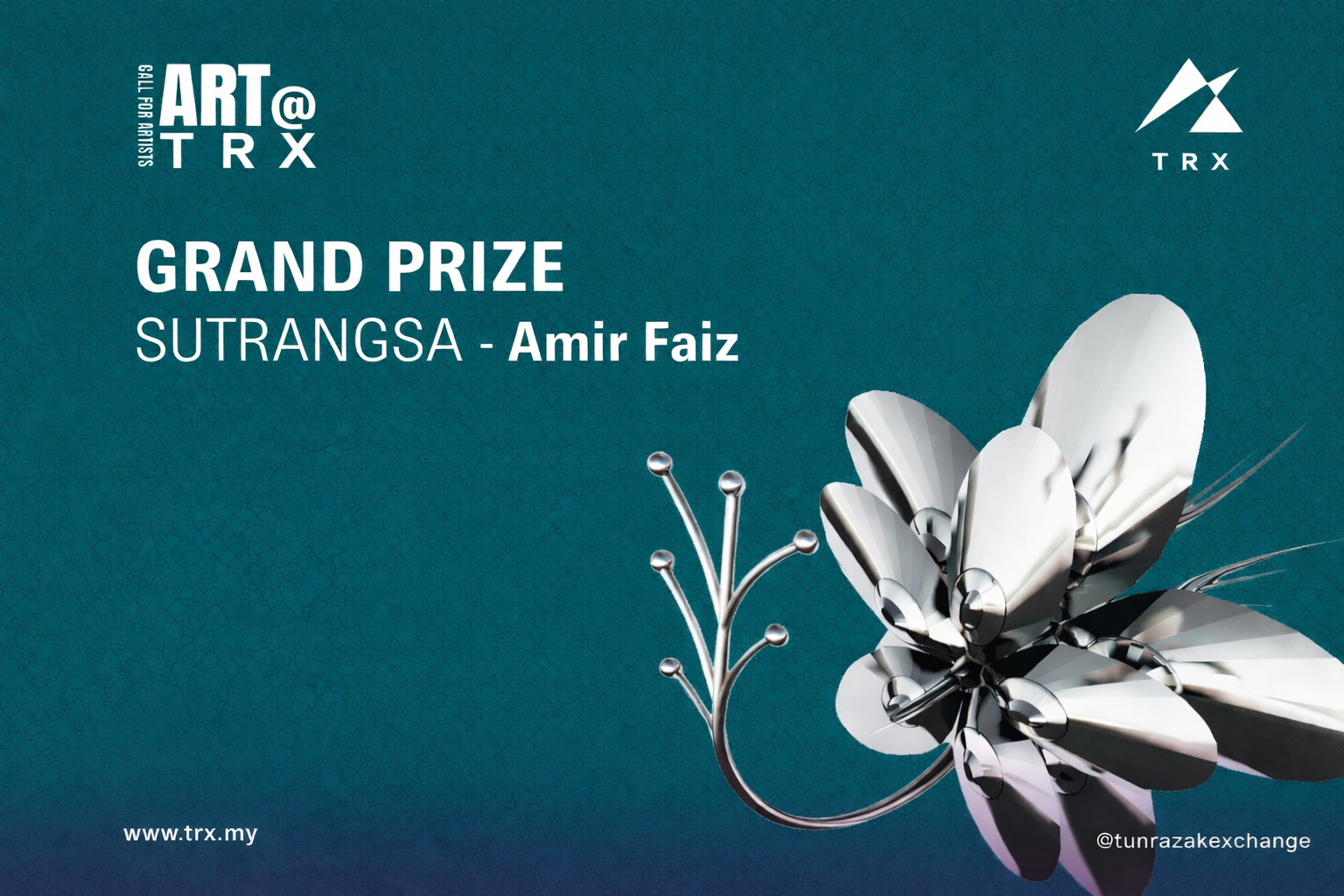
Open Category Grand Prize: SUTRANGSA by Amir Faiz
Sutrangsa, the Grand Prize winner of the ART@TRX Open Category, reimagines the Bunga Raya as a contemporary public sculpture for TRX. Designed by Malaysian landscape architect and artist Amir Faiz, the work translates unity, heritage, and progress into a form that belongs naturally within the public realm of the city.
About the Artist: Amir Faiz
Amir Faiz is a Malaysian Landscape Architect and Landscape Artist Illustrator based in Selangor. His work bridges design and art, using public spaces as a canvas to express cultural memory, environmental identity, and community connection.
Throughout his career, Amir has contributed to urban art installations, wayfinding projects, and public space initiatives across Malaysia. His practice often explores how tradition, material, and people can come together to shape meaningful spatial experiences. This philosophy forms the foundation of Sutrangsa.
The Story Behind Sutrangsa
The name Sutrangsa carries the philosophy:
“Dari Akar Yang Sama, Kita Membangun Malaysia.”
The sculpture draws a parallel between Malaysia’s journey and the transformation of the TRX site itself. Once part of Kuala Lumpur’s old Imbi district, the area has evolved into the nation’s international financial district. This idea of growth, change, and continuity is reflected in the unfolding form of the sculpture.
Sutrangsa becomes a symbol of how shared roots can shape a modern, forward-looking identity.
Inspiration: Rattan Weaving, Batik, and Handcrafted Malaysia
Rather than referencing buildings, Amir looked to traditional Malaysian crafts for inspiration.
-
Rattan weaving represents adaptability and interconnected cultures
-
Batik reflects diverse cultural expressions across communities
-
Handcrafted traditions show how heritage is shaped by human touch
These influences are translated into flowing, interwoven forms that resemble both woven strands and hibiscus petals, creating a sculpture that feels cultural, organic, and contemporary at the same time.
The Concept: Malaysia’s Largest Bunga Raya Sculpture
Sutrangsa is envisioned as Malaysia’s largest Bunga Raya sculpture, standing approximately 5 metres tall and 7.25 metres wide within the TRX public realm.
The sculpture is proposed in mirror-polished Grade 316 stainless steel, chosen for its durability in tropical conditions, recyclability, and highly reflective finish. Its surface mirrors the sky, surrounding buildings, and people moving through the space, allowing the sculpture to constantly change with light and movement throughout the day.
Each petal is engineered using a layered stainless-steel framework supported by an internal tubular structure, ensuring both visual lightness and structural stability for long-term public installation.
In the heart of a modern financial district, Sutrangsa stands as a reminder that Malaysia’s strength lies in its unity, heritage, and shared growth.
__________________________________

Open Category Runner-up: I.B.U — Interconnection, Balance & Unification by Fuad Arif
Selected as the Runner-up of the ART@TRX Open Category, I.B.U by Malaysian artist and academic Fuad Arif translates traditional Malay visual language into a contemporary public sculpture that speaks about care, balance, and connection within the city.
About the Artist: Fuad Arif
Fuad Arif is a Senior Lecturer in Fine Art at Universiti Teknologi MARA (UiTM) and an established Malaysian contemporary artist with over two decades of exhibition, public art, and academic experience.
A PhD holder in Fine Art Studio Practice, Fuad’s works often explore material, form, and meaning through cultural references and reflective processes. His background in sculpture, research, and public art practice is evident in I.B.U, where conceptual depth is supported by strong technical and structural thinking.
The Story Behind I.B.U
The title I.B.U carries layered meaning.
“Ibu” in Malay means mother, origin, and nurturer. It also references Ibu Kota, the capital city of Malaysia, Kuala Lumpur.
The sculpture’s looping, continuous form evolved from Fuad’s study of sulur (tendril) motifs in traditional Malay woodcarving. Through an intuitive and research-driven process, this flowing line gradually transformed into the symbolic figure of a reclining mother.
Placed within TRX, I.B.U becomes a quiet counterpoint to the towering presence of Exchange 106. Where the tower rises vertically as a symbol of ambition, I.B.U rests horizontally at ground level, representing care, reflection, and balance within the city’s momentum.
Inspiration: Sulur Motif and the Reclining Mother Form
The primary visual inspiration comes from the flowing sulur motifs of traditional Malay woodcarving, symbolising growth, continuity, and connection.
These interwoven lines are reinterpreted into a fluid stainless-steel form that people can walk around and experience from multiple angles. The sculpture also references artistic depictions of maternal rest seen in both Malaysian and international art history, reimagined here as a monumental public gesture.
The Concept: A Monumental Loop in Stainless Steel
I.B.U is proposed as a large-scale outdoor sculpture measuring approximately:
-
7 metres in height (23 ft)
-
11.9 metres in length (39 ft)
The sculpture is fabricated from mirror-polished Grade 316 stainless steel with a #8 finish. Its hollow cylindrical form has a diameter of 550 mm, terminating in two 800 mm stainless steel spheres at each end.
The reflective surface captures the surrounding architecture, people, and light throughout the day, turning the sculpture into a living, changing presence within the plaza.
Structurally, the sculpture rests on four cylindrical concrete bases, each approximately 1.5 metres in diameter and 1 metre deep, concealed beneath the form to maintain the illusion of a continuous flowing loop. The work is engineered in multiple transportable sections, welded seamlessly on site for stability and durability as a long-term public installation.
Through its scale, material, and form, I.B.U introduces a powerful sense of grounding within TRX — a reminder that within progress and movement, there is also space for care, balance, and human connection.
__________________________________
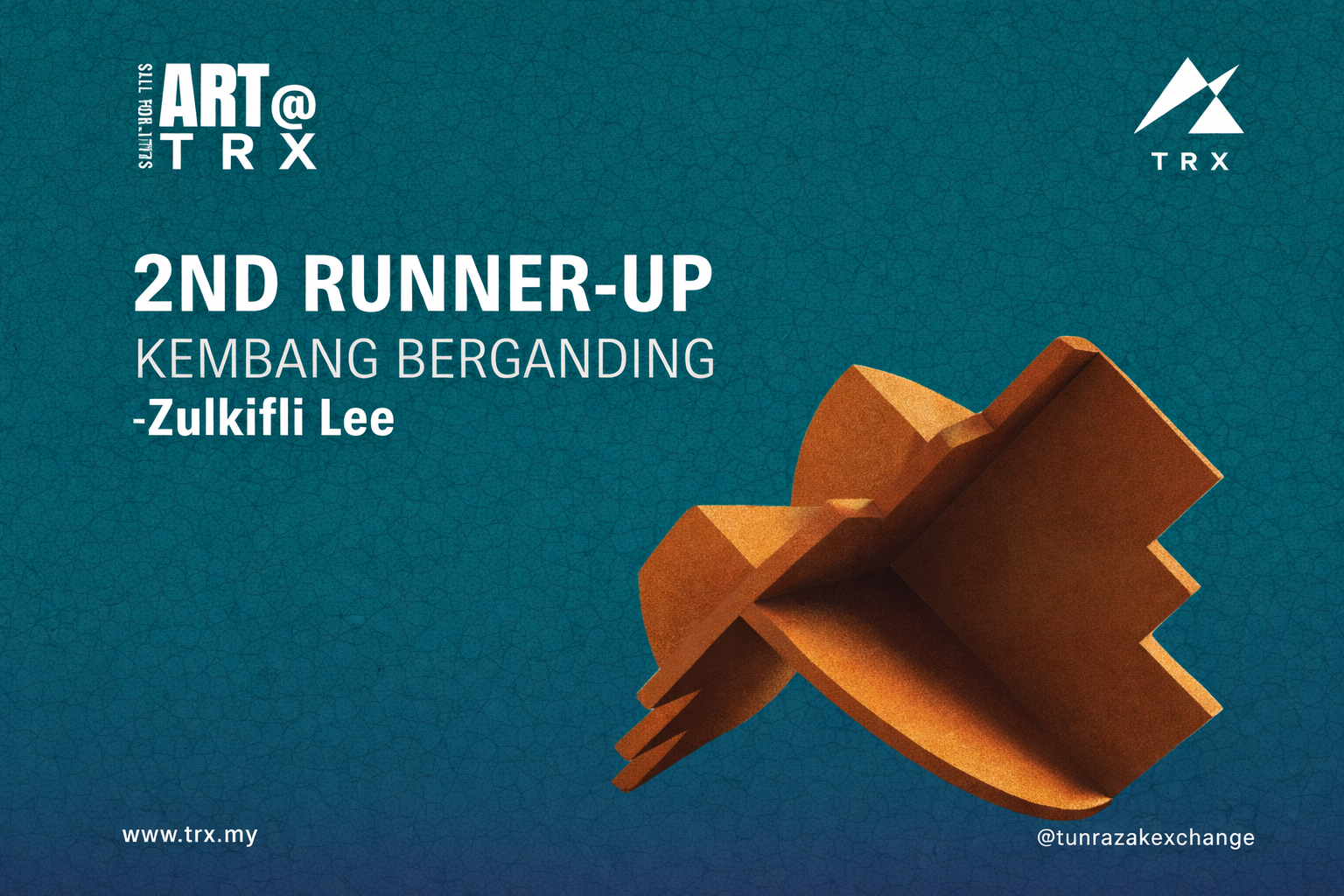
Open Category 2nd Runner-up: Kembang Berganding by Zulkifli Lee
Selected as the 2nd Runner-up of the ART@TRX Open Category, this sculpture by Malaysian multidisciplinary artist Zulkifli Lee explores how opposing forms can meet, clasp, and stand as one unified structure within the public realm.
About the Artist: Zulkifli Lee
Zulkifli Lee is a Malaysian multidisciplinary artist working across painting, sculpture, and installation. A graduate of Universiti Teknologi MARA with a Master’s in Fine Art and Technology, his practice explores the relationship between organic and industrial materials, often allowing natural processes to become part of the artwork itself.
His works have been exhibited widely in Malaysia and internationally, including Singapore, Jakarta, London, and Hong Kong. His pieces are held in major collections such as the Singapore Art Museum, ILHAM Foundation, Khazanah Nasional, and Muzium Seni Kontemporari Kuantan.
The Story Behind Kembang Berganding
Kembang Berganding, which translates to “Blooming Together,” is rooted in Zulkifli’s ongoing exploration of contradiction and equality.
The sculpture investigates how exchange happens not through separation, but through alignment. Angular and curvy steel forms are deliberately designed to intersect and interlock, allowing the structure to stand through its interdependence.
This idea mirrors the exchanges that happen in TRX daily, where differences meet, share space, and create something stronger together.
Inspiration: Songket Pattern and Universal Forms
The design draws from two contrasting visual references:
-
Angular forms inspired by traditional songket patterns, representing strength, tradition, and past wisdom
-
Curved forms inspired by the circle, a universal symbol of unity, infinity, and perfection
These opposing characteristics are not placed apart, but physically clasped together. From different viewing angles, the dominance of each form shifts, creating a constantly changing visual balance for the viewer.
The Concept: A Monumental Form in Corten Steel
Kembang Berganding is designed as a large-scale public sculpture measuring approximately:
-
4.27 metres (L) x 4.27 metres (W) x 3.09 metres (H)
-
10 cm thick Corten steel plates
-
Estimated weight: 30,000 kg
The sculpture is fabricated using Corten steel, also known as weathering steel. This material is designed to naturally oxidise, forming a protective rust layer that strengthens the steel over time without the need for paint or heavy maintenance.
Its warm, earthy patina evolves with age, allowing the sculpture to feel both industrial and organic at once, reflecting the relationship between man-made structure and natural process.
Structurally, the work relies on hidden I-beams, concrete footing, and anchoring systems beneath the surface to support the interlocking steel plates, allowing the sculpture to appear as a single converging form above ground.
Through material, form, and balance, Kembang Berganding becomes a statement about unity, shared strength, and the spaces where differences meet and empower one another.
__________________________________
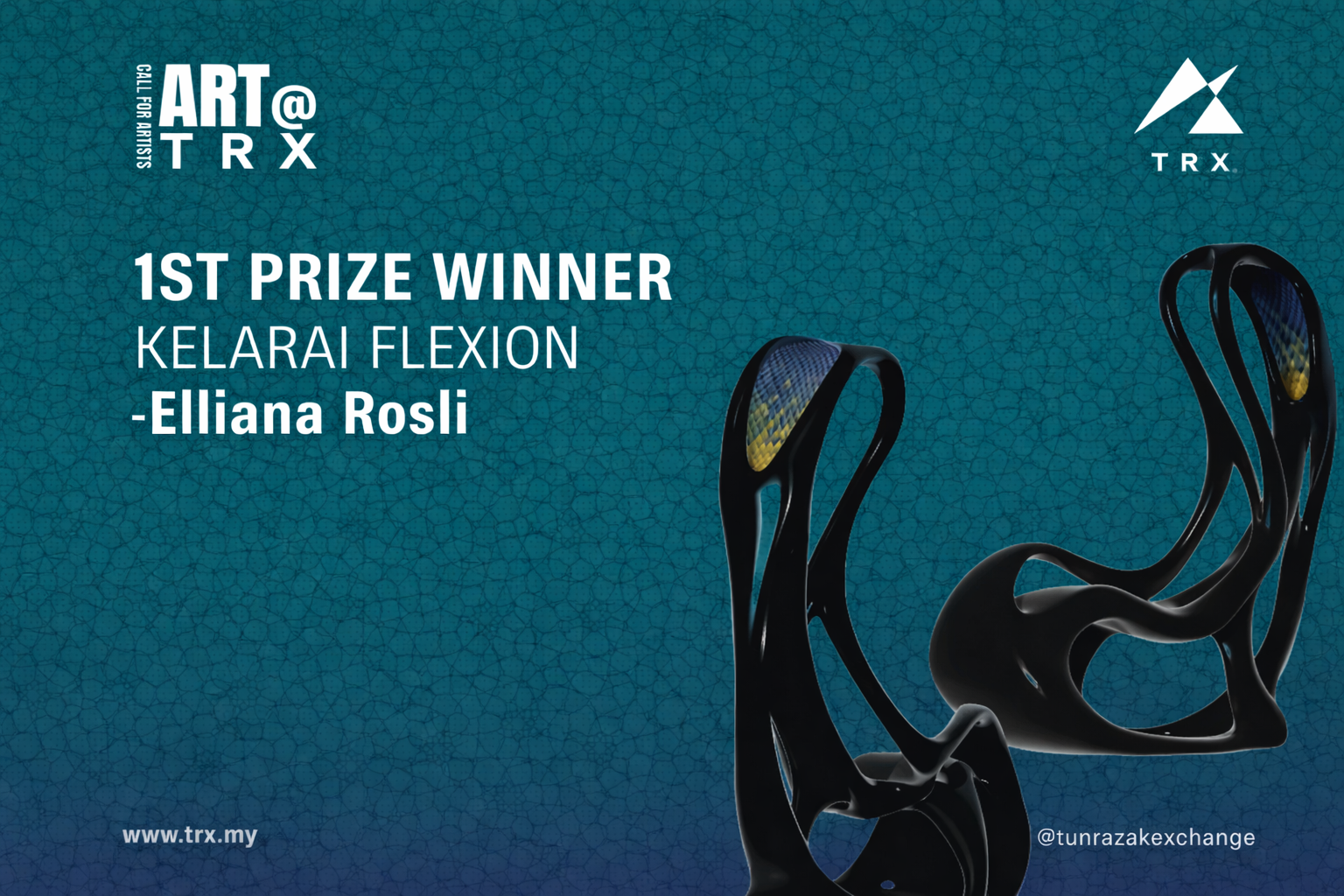
Student Category 1st Prize: Kelarai Flexion by Siti Nor Elliana Rosli
Winner of the Student Category 1st Prize, Kelarai Flexion reimagines traditional Mah Meri kelarai weaving as a bold, functional sculptural seating installation. Designed by Siti Nor Elliana Rosli, the work transforms indigenous craft into a contemporary public furnishing that invites interaction while celebrating Malaysia’s cultural roots.
About the Artist: Siti Nor Elliana Rosli
Siti Nor Elliana Rosli is a Master’s student in Industrial Design and Innovation at Universiti Putra Malaysia. Her practice focuses on reinterpreting Malaysia’s cultural heritage through sustainable, contemporary design approaches that engage urban audiences.
Her work explores the meeting point between traditional craftsmanship, material innovation, and urban identity. Through Kelarai Flexion, Elliana brings indigenous narratives into modern city spaces, ensuring that heritage remains visible and relevant within today’s landscape.
The Story Behind Kelarai Flexion
Kelarai Flexion was conceived under the ART@TRX theme, Intersection of Exchanges.
The sculpture draws from the flowing biomorphic language seen in contemporary architecture and combines it with the ancestral Mah Meri Harimau Berantai spirit carvings and intricate kelarai pandanus weaving. This fusion reflects Kuala Lumpur’s identity as a city rooted in heritage while evolving into a global centre.
Placed within TRX, the work becomes more than seating. It offers a shared space for people to pause, gather, and reflect within the movement of the city.
Inspiration: Mah Meri Kelarai Weaving and Harimau Berantai Forms
The design takes inspiration from:
-
Mah Meri kelarai pandanus weaving, symbolising resilience, continuity, and interconnected communities
-
Harimau Berantai spirit sculptures, influencing the fluid, organic form of the structure
-
Contemporary biomorphic design language that mirrors the dynamism of Kuala Lumpur
The woven kelarai panels are deliberately placed at the crest of the structure as a gesture of respect, elevating indigenous artisanship into the modern skyline of TRX.
The Concept: Functional Sculpture in Fiberglass and Pandanus Weaving
Kelarai Flexion is designed as a functional public furnishing with approximate dimensions of 152 cm (L) x 152 cm (H) x 60 cm (W).
The structure is constructed using fiberglass with resin reinforcement, chosen for its strength, lightweight properties, and durability in Malaysia’s tropical outdoor environment.
Integrated into the form are handwoven pandanus panels by Mah Meri artisans, encapsulated in clear epoxy resin to protect the craft from weather while preserving its texture and authenticity. The sculpture is finished with a dark satin metallic coating to minimise glare and harmonise with TRX’s architectural surroundings.
A QR code panel is also incorporated into the design, allowing visitors to access Mah Meri cultural narratives digitally, extending the experience beyond the physical sculpture.
__________________________________
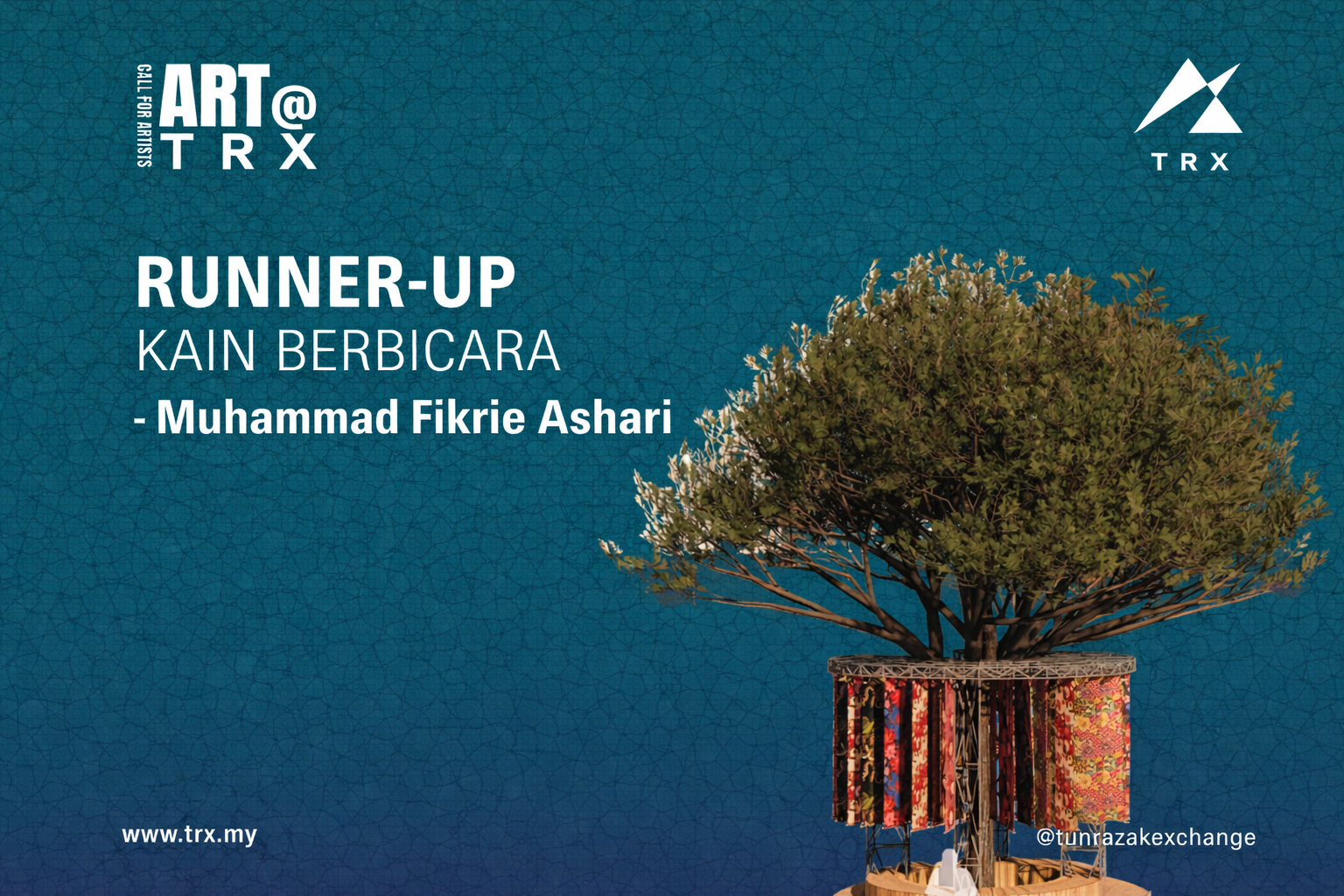
Student Category Runner-up: Kain Berbicara by Muhammad Fikrie Ashari
Runner-up of the Student Category, this installation by Muhammad Fikrie Ashari reinterprets the timeless craft of Malaysian batik into a public sculpture that speaks about unity through patterns, light, and movement.
About the Artist: Muhammad Fikrie Ashari
Muhammad Fikrie Ashari is a young Malaysian designer with a background in architecture and spatial design. His work often explores how traditional Malaysian motifs and materials can be translated into contemporary structures that engage people within urban spaces.
Through Kain Berbicara, Fikrie demonstrates how cultural storytelling can move beyond surfaces and become something people can walk around, sit within, and experience physically.
The Story Behind Kain Berbicara
Kain Berbicara, which means “The Fabric Speaks,” is inspired by the idea that Malaysian batik carries stories, identities, and histories through its patterns.
The installation transforms these patterns into vertical panels arranged in a circular form, creating a sheltered space beneath a tree within TRX. As light passes through the batik panels, shifting shadows and colours create a living dialogue between material, memory, and place.
The work invites visitors to move through it, pause, and experience how individual patterns, like individual cultures, form a harmonious whole when brought together.
Inspiration: Malaysian Batik and Shared Cultural Identity
The design draws directly from:
-
Traditional Malaysian batik motifs, where each pattern represents a different cultural voice
-
The idea of fabric moving in the wind, translated into hanging vertical panels
-
The meeting point between art, architecture, and public interaction
Set within TRX, the installation becomes a meeting ground for stories, where heritage and contemporary space intertwine.
The Concept: Batik Panels within a Steel and Timber Structure
Kain Berbicara is designed as a circular installation measuring approximately 4 metres in height and 4 metres in diameter.
The structure consists of:
-
A steel column and top supporting steel frame
-
Vertical batik fabric panels measuring approximately 1000 mm x 2200 mm each
-
A circular timber seating platform at the base, allowing visitors to sit within the installation
The interwoven steel structure supports the hanging batik panels, allowing them to move gently with air flow while casting patterned light onto the seating area below. This creates a constantly changing visual experience throughout the day.
Through material, pattern, and space, Kain Berbicara turns Malaysian textile heritage into an immersive public environment within TRX.